
Castles in the Sand: A Tale of Ancient Walls and Modern Woes 🏰🌍
In an era where technology reigns supreme and warfare has evolved beyond swords and shields, the capture of a medieval castle might strike one as an anachronism of epic proportions. And yet, here we find ourselves, with Israel seizing an ancient fortress in Lebanon, shattering any illusions that the past is truly behind us. Are we to witness a tale from the Middle Ages unfolding amidst our modern geopolitical tapestries? 🤔
Walls of Old in a World of New
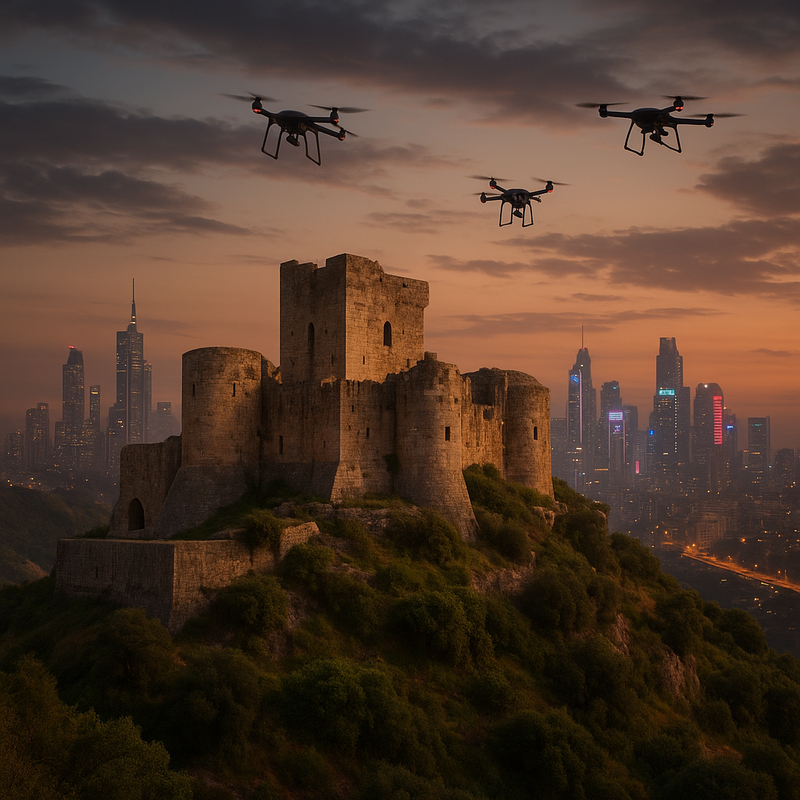
The irony is not lost in this situation: a nation with one of the most advanced defense systems in the world capturing a stone bastion from a bygone era. As Israel expands its ground offensive, one can’t help but think of that castle as an ancient relic caught in the whirlwinds of contemporary geopolitical turmoil. It is as though a knight in rusted armor has been thrust into a cybernetic battlefield. 🏇🛡️
Yet, as we strip away the layers of drama, a striking antithesis emerges—a clash not just of eras, but of ideologies. On one side stands a nation fortified with state-of-the-art weaponry, and on the other lies an olden symbol of endurance. Here, the tension between modern political stratagems and deep-rooted historical narratives is as palpable as the very stones that make up the castle walls.
The Human Element Behind the Stronghold
Amidst the clamor of international politics, we often forget the human lives intertwined with these grand narratives. As Israeli forces take control of the castle, one might wonder about the people who once found refuge within its sturdy embrace, much like a lighthouse steadfast in a relentless storm. 🏯💔
In Lebanon, the castle is more than just a relic; it is a testament to resilience in a landscape often marred by conflict. The irony lies in the contrast between its enduring stone and the fleeting political whims of its new captors. To those who know it well, the castle stands as a poignant simile for their own struggle to withstand the sands of time and tides of turmoil.
The Paradox of Progress
If we zoom out and look at the larger picture, what does this capture say about our present and future? Are we progressing forward if the tactics and territories of yesteryear continue to sculpt our present? Or, perhaps we are sailing in a sea of paradox where progress and regression ebb and flow like tides guided by some celestial irony. 🌊⚔️
In the end, the capture of this castle may serve as a mirror, reflecting the eternal dance between history and modernity. It leaves us pondering whether the real victory lies not in the occupation of stones but in the reconciliation of past and present. Are we not all, in some form, castles in the sand, standing resilient against the tides of change? 🏰🏖️
A Closing Thought
As the world watches this unfolding saga, let us remember that while walls of old may fall or change hands, the lasting battle lies within our collective conscience. For in the end, the castles we build—or dismantle—within, may well be the ones that define us. 🌎❤️
As you close this reflection, ask yourself: what fortresses do we hold onto in the battlefields of our mind? And are they fortifications of protection, or of division?